Example 1
A cubic with a maximum and a minimum
Differentiate and factor:
The critical points are x = −1 and x = 3. Use f″(x) = 6x − 6:
Function values: f(−1) = 10 and f(3) = −22.
Answer
Find every critical point of a function in an interval and classify each one as a local maximum, a local minimum or neither. Roots are exact whenever the derivative factors nicely; otherwise they are found numerically and marked as approximate.
Try an example
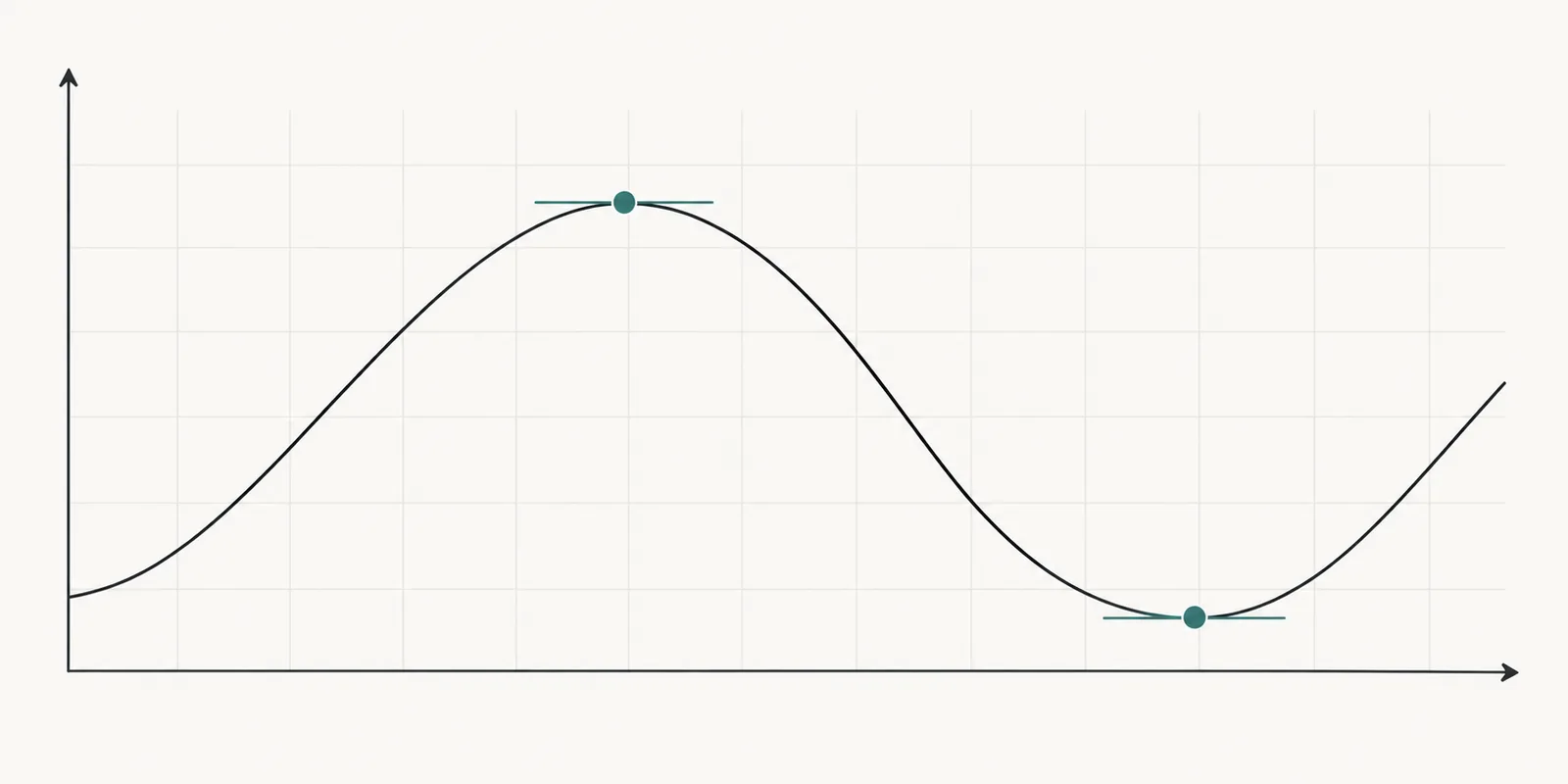
A critical point of f is a number c in the domain of f where either f′(c) = 0 (a horizontal tangent) or f′(c) does not exist (a corner, cusp or vertical tangent). Fermat's theorem says every local maximum or minimum of a function on an open interval occurs at a critical point.
The converse is false: not every critical point is an extremum. f(x) = x³ has f′(0) = 0, but the graph keeps rising through the origin. That is why critical points must be classified.
Two standard tests decide what kind of point each candidate is.
Quick when f″ is easy to evaluate. It is inconclusive when f″(c) = 0.
Look at the sign of f′ just left and right of c. It also works where f′ is undefined.
The graph flattens momentarily but keeps going the same way, as x³ does at 0.
The calculator differentiates f with full steps, then splits f′ into a numerator and a denominator. Polynomial factors of the numerator are solved exactly, using the rational root theorem and then the quadratic formula. That is how answers like x = ±√2 appear in exact form.
Zeros of the denominator, and of any absolute value inside f′, are candidates where f′ is undefined; they count only if f itself is defined there. A dense numerical scan of the search interval then catches any remaining roots, such as those of trigonometric or exponential derivatives.
Each point is classified with the second derivative test when f″ is nonzero, and with the first derivative test otherwise. The function value at each point is computed exactly when possible.
For the full details, including how answers are verified, see how the solver works.
Work through these by hand first, then enter them above to compare each step.
Example 1
Differentiate and factor:
The critical points are x = −1 and x = 3. Use f″(x) = 6x − 6:
Function values: f(−1) = 10 and f(3) = −22.
Answer
Example 2
Differentiate and factor completely:
Classify with f″(x) = 12x² − 4:
Answer
Example 3
The derivative has x in the denominator:
f′(x) is never 0, but it is undefined at x = 0, where f(0) = 0 is defined. f′ changes from negative to positive there.
Answer
Example 4
Product rule:
Since e^(−x) > 0 always, f′ = 0 only at x = 1, where f′ changes from + to −.
Answer
x⁴ has f″(0) = 0 yet a clear minimum at 0. When the second derivative test is inconclusive, switch to the first derivative test.
|x| and x^(2/3) have their minimum exactly where f′ fails to exist. Check the denominator of f′ as well as the numerator.
For f(x) = 1/x, f′ is undefined at 0, but 0 is not in the domain of f, so it is not a critical point.
On a closed interval [a, b], the absolute maximum may occur at an endpoint. Compare the endpoint values with the critical values yourself.
No. Every local extremum (in the interior of the domain) is a critical point, but some critical points are neither, like x = 0 for x³. Classification decides which is which.
The second derivative test is then inconclusive, so the calculator falls back to the first derivative test, checking the sign of f′ on each side of the point.
When the derivative does not factor into polynomials, the critical points are found numerically to about 10 significant digits and marked with ≈ so you know they are approximations.
Yes. Edit the “Search from” and “Search to” boxes. Narrow intervals give the numerical search more precision; wide ones help when you don't know where the points are.
Pick one of the worked examples, solve it on paper, then enter it in the calculator and compare your steps with each rule shown. Spotting where your work differs is the fastest way to improve.
Back to the calculator