Skip to content
Calculus Solver

Integration Techniques: How to Choose the Right Method

Integration is harder than differentiation because no single procedure always works. Instead, you recognise the shape of the integrand and pick the matching technique. This guide gives you a decision order and explains each technique with an example.

Last reviewed:

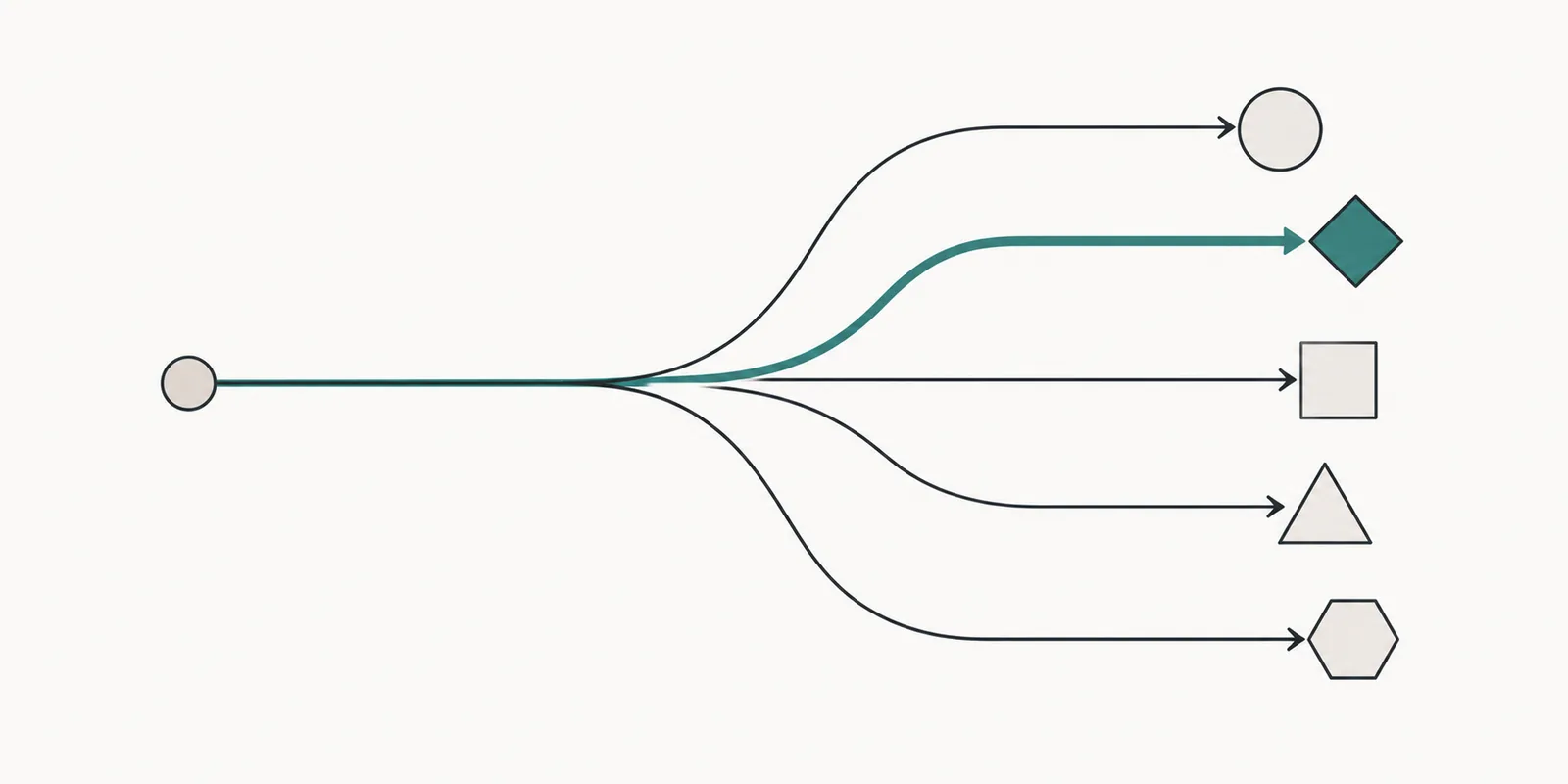
One path branching into several routes, each ending at a different shape, representing the choice of integration technique

A decision order for any integral

  • Simplify: expand products, split fractions with a single-term denominator, use identities.
  • Is it a basic form? Check the table of standard integrals.
  • Is there a function and its derivative? Try u-substitution.
  • Is it a product of different types of function, such as x·eˣ or x·sin x? Try integration by parts.
  • Is it a ratio of polynomials? Use long division, then partial fractions.
  • Powers of sin and cos? Use power-reducing or Pythagorean identities.

u-substitution

∫f(g(x))g′(x) dx=∫f(u) du\int f\big(g(x)\big)g'(x)\,dx = \int f(u)\,du

Look for an inner function whose derivative also appears as a factor, possibly up to a constant multiple. Set u equal to that inner function, replace dx using du = g′(x) dx, and check that no x is left over. If some x remains, the choice of u was wrong or substitution alone will not work.

Good candidates for u are the inside of a power, the exponent of e, the argument of a trig function, or a denominator whose derivative is the numerator.

Integration by parts

∫u dv=uv−∫v du\int u\,dv = uv - \int v\,du

Integration by parts reverses the product rule. Choose u as the factor that gets simpler when differentiated, using LIATE as a guide: Logarithms, Inverse trig, Algebraic, Trigonometric, Exponential. Choose dv as the rest, which must be something you can integrate.

Polynomials times eˣ or sin x need one round of parts per degree of the polynomial. Products like eˣ·cos x return to the original integral after two rounds, which can then be solved for algebraically.

Trigonometric integrals

sin⁡2x=1−cos⁡2x2,cos⁡2x=1+cos⁡2x2\sin^{2}x = \frac{1 - \cos 2x}{2}, \qquad \cos^{2}x = \frac{1 + \cos 2x}{2}

Even powers of sine and cosine are lowered with these power-reducing identities. For an odd power, split off one factor and convert the rest using sin²x + cos²x = 1; the leftover factor becomes du in a substitution.

Partial fractions

For a rational function P(x)/Q(x), first divide if the degree of P is at least the degree of Q. Then factor Q and write the fraction as a sum of simpler pieces: A/(x − r) for each linear factor, and (Bx + C)/(quadratic) for each irreducible quadratic factor. Linear pieces integrate to logarithms; irreducible quadratics give a logarithm plus an arctangent.

1(x−1)(x+2)=1/3x−1−1/3x+2\frac{1}{(x-1)(x+2)} = \frac{1/3}{x - 1} - \frac{1/3}{x + 2}

When there is no elementary answer

Some integrals cannot be expressed with elementary functions at all. Common examples are ∫e^(−x²) dx, ∫sin(x)/x dx and ∫1/ln(x) dx. This is a proven fact, not a gap in technique. For such integrands, definite integrals are computed numerically.

Worked examples

Example 1

Substitution with a constant adjustment

∫x(x2+1)3dx\int x\left(x^{2} + 1\right)^{3}dx
  1. Let u = x² + 1, so du = 2x dx and x dx = du/2.

    12∫u3 du=u48+C\frac{1}{2}\int u^{3}\,du = \frac{u^{4}}{8} + C

Answer

(x2+1)48+C\frac{\left(x^{2} + 1\right)^{4}}{8} + C

Example 2

Parts twice: x² eˣ

∫x2ex dx\int x^{2}e^{x}\,dx
  1. u = x², dv = eˣ dx:

    x2ex−∫2x ex dxx^{2}e^{x} - \int 2x\,e^{x}\,dx
  2. Parts again with u = 2x:

    x2ex−(2xex−2ex)x^{2}e^{x} - \left(2x e^{x} - 2e^{x}\right)

Answer

ex(x2−2x+2)+Ce^{x}\left(x^{2} - 2x + 2\right) + C

Example 3

Partial fractions with two linear factors

∫1(x−1)(x+2) dx\int \frac{1}{(x-1)(x+2)}\,dx
  1. Split into A/(x − 1) + B/(x + 2) with A = 1/3 and B = −1/3, then integrate each.

    13ln⁡∣x−1∣−13ln⁡∣x+2∣+C\frac{1}{3}\ln|x - 1| - \frac{1}{3}\ln|x + 2| + C

Answer

13ln⁡∣x−1x+2∣+C\frac{1}{3}\ln\left|\frac{x - 1}{x + 2}\right| + C

Questions about this topic

How do I know whether to use substitution or integration by parts?

If one part of the integrand is (up to a constant) the derivative of another part, use substitution. If the integrand is a product of two unrelated kinds of function, such as a polynomial times an exponential, use integration by parts.

Why do different methods give answers that look different?

Antiderivatives are only unique up to a constant, and trig identities can rewrite the same function in many ways. Differentiate each answer to confirm that both are correct.

Practise what you learned

Try the worked examples above in the calculator and compare each step with your own. You can also use the main Calculus Solver for every operation in one place.

Practise with the Integral Calculator